Tuesday, November 20, 2012

Sculpting in Time.

I was on a short holiday, and that was the the reason why last week's film club didn't happen. But this week we'll have another BIG name on the screen just so you don't be too disappointed for the long wait.
I'm talking of course of yet another one of Tarkovsky's greats (are any non Tarkovsy-greats?).
There are so many things written, said  felt and dreamed about Solaris, that I don't feel apt to comment on the sidelines of this fantastic piece of cinematographic poetry.
Here is a "copy-paste" article from Nostalgia.com:
Tarkovsky and Solaris

This piece was originally written for the Asahi Shinbun Newspaper, and published in the evening edition, on 13 May, 1977. It was reproduced, with the addition of the photo of Kurosawa and Tarkovsky on pages 2-3 of the Solaris pamphlet. It was also published in Nihonkai Eigasha, June 1978, on pages 40-43. It was again published in Image Forum No. 80, 1987 March special issue, Daguerreo Press, Inc., 1987, pp. 216-220, under a different title: "Solaris: A Nostalgy toward Nature on Great Earth." Finally, the article appeared in "The Complete Akira Kurosawa," Vol 6, Iwanami Shoten Publishers, Tokyo, 1988. ISBN 4-00-091326-3, with the original title, "Tarkovsky and Solaris." The article was translated for Nostalghia.com by our Japan correspondent SATO Kimitoshi. It appears here for the first time in English. This piece was subsequently adapted by Criterion for use in the insert booklet of their Solaris DVD.

I met Tarkovsky for the first time when I attended my welcome luncheon at the Mosfilm during my first visit to Soviet Russia. He was small, thin, looked a little frail, and at the same time exceptionally intelligent, and unusually shrewd and sensitive. I thought he somehow resembled Toru Takemitsu, but I don't know why. Then he excused himself saying, "I still have work to do," and disappeared, and after a while I heard such a big explosion as to make all the glass windows of the dining hall tremble hard. Seeing me taken aback, the boss of the Mosfilm said with a meaningful smile: "You know another world war does not break out. Tarkovsky just launched a rocket. This work with Tarkovsky, however, has proved a Great War for me." That was the way I knew Tarkovsky was shooting Solaris.

After the luncheon party, I visited his set for Solaris. There it was. I saw a burnt down rocket was there at the corner of the space station set. I am sorry I forgot to ask him as to how he had shot the launching of the rocket on the set. The set of the satellite base was beautifully made at a huge cost, for it was all made up of thick duralumin.

It glittered in its cold metallic silver light, and I found light rays of red, or blue or green delicately winking or waving from electric light bulbs buried in the gagues on the equipment lined up in there. And above on the ceiling of the corridor ran two duralumin rails from which hanged a small wheel of a camera which could move around freely inside the satellite base.

Tarkovsky guided me around the set, explaining to me as cheerfully as a young boy who is given a golden opportunity to show someone his favorite toybox. Bondarchuk, who came with me, asked him about the cost of the set, and left his eyes wide open when Tarkovsky answered it. The cost was so huge: about six hundred million yen as to make Bondarchuk, who directed that grand spectacle of a movie "War and Peace," agape in wonder.

Now I came to fully realize why the boss of the Mosfilm said it was "a Great War for me." But it takes a huge talent and effort to spend such a huge cost. Thinking "This is a tremendous task" I closely gazed at his back when he was leading me around the set in enthusiasm.

Concerning Solaris, I find many people complaining that it is too long, but I do not think so. They especially find too lengthy the description of nature in the introductory scenes, but these layers of memory of farewell to this earthly nature submerge themselves deep below the bottom of the story after the main character has been sent in a rocket into the satellite station base in the universe, and they almost torture the soul of the viewer like a kind of irresistible nostalghia toward mother earth nature, which resembles homesickness. Without the presence of beautiful nature sequences on earth as a long introduction, you could not make the audience directly conceive the sense of having-no-way-out harboured by the people "jailed" inside the satellite base.

I saw this film late at night in a preview room in Moscow for the first time, and soon I felt my heart aching in agony with a longing to returning to the earth as quickly as possible. Marvellous progress in science we have been enjoying, but where will it lead humanity after all? Sheer fearful emotion this film succeeds in conjuring up in our soul. Without it, a science fiction movie would be nothing more than a petty fancy.

These thoughts came and went while I was gazing at the screen.

Tarkovsky was together with me then. He was at the corner of the studio. When the film was over, he stood up, looking at me as if he felt timid. I said to him, "Very good. It makes me feel real fear." Tarkovsky smiled shyly, but happily. And we toasted vodka at the restaurant in the Film Institute. Tarkovsky, who didn't drink usually, drank a lot of vodka, and went so far as to turn off the speaker from which music had floated into the restaurant, and began to sing the theme of samurai from Seven Samurai at the top of his voice.

As if to rival him, I joined in.

For I was at that moment very happy to find myself living on Earth.

Solaris makes a viewer feel this, and even this single fact shows us that Solaris is no ordinary SF film. It truly somehow provokes pure horror in our soul. And it is under the total grip of the deep insights of Tarkovsky.

There must be many, many things still unknown to humanity in this world: the abyss of the cosmos which a man had to look into, strange visitors in the satellite base, time running in reverse, from death to life, strangely moving sense of levitation, his home which is in the mind of the main character in the satellite station is wet and soaked with water. It seems to me to be sweat and tears that in his heartbreaking agony he sqeezed out of his whole being. And what makes us shudder is the shot of the location of Akasakamitsuke, Tokyo, Japan. By a skillful use of mirrors, he turned flows of head lights and tail lamps of cars, multiplied and amplified, into a vintage image of the future city. Every shot of Solaris bears witness to the almost dazzling talents inherent in Tarkovsky.

Many people grumble that Tarkovsky's films are difficult, but I don't think so. His films just show how extraordinarily sensitive Tarkovsky is. He made a film titled Mirror after Solaris. Mirror deals with his cherished memories in his childhood, and many people say again it is disturbingly difficult. Yes, at a glance, it seems to have no rational development in its storytelling. But we have to remember: it is impossible that in our soul our childhood memories should arrange themselves in a static, logical sequence.

A strange train of fragments of early memory images shattered and broken can bring about the poetry in our infancy. Once you are convinced of its truthfulness, you may find Mirror the easiest film to understand. But Tarkovsky remains silent, without saying things like that at all. His very attitude makes me believe that he has wonderful potentials in his future.

There can be no bright future for those who are ready to explain everything about their own film.

__________________________

When: Wednesday, 21.11.12, 18:30

__________________________

Where: GSN Room, Ground Floor, Biocenter

__________________________

Solaris (1972) 

Director: Andrei Tarkovsky

IMDB: HERE!


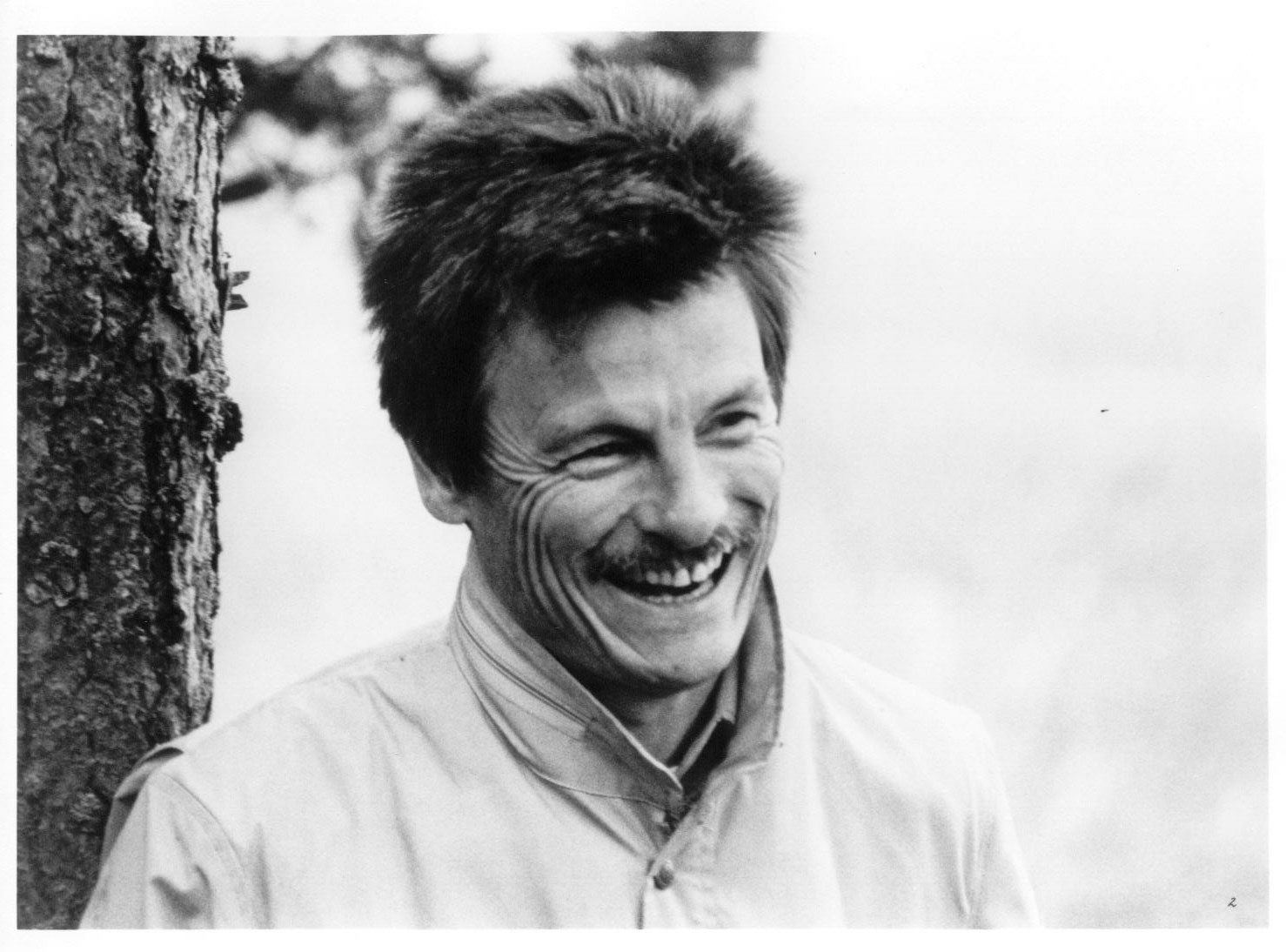
Stills of Andrei:


Tuesday, November 6, 2012

Elect your leader...


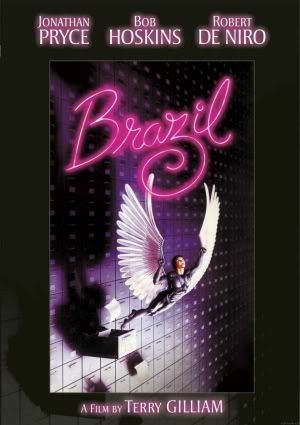
As the US had by the time of the screening already elected their new (or old) president, I propose watching a quite funny yet none of the less provocative shot by the "Monty Python and the Holy Grail" director Terry Gilliam - Brazil (1985). By the way he also Co-wrote a good part of the Flying Circus, The Life of Brian, The Meaning of life, Fear and Loathing in Las Vegas (which he also directed) to name just some of his "better-known" titles.
So why should this film be of any relevance to the election process? Well, it turns out that the action is placed somewhere in the not so distant future, but somehow everything got overly bureaucratic and controlled. A world where no mistakes are supposed to happen, but which as it turns out, are happening every moment. So called terrorists are lurking everywhere and the frequent bombing do not really bother anybody anymore. They just continue eating... A messy reality, on a further orbit than that which we confront on a daily basis, yet still close enough to allow parallels to be drawn. However you look at it - it's great comedy, fantastic sarcasm and great imagery. On BlueRay!


____________________
When: Wednesday (7.11.2012), 18:30
____________________
Where: GSN Room, Biocenter, ground floor
____________________

Brazil (1985)

Director: Terry Gilliam

Starring: Jonathan Pryce
                Robert De Niro
                Katherine Helmond  

IMDB: HERE!


Tuesday, October 23, 2012

Viewer's Choice

Because I couldn't make up my mind regarding which film we should watch this week, I decided to let you the freedom to choose between one of the two titles Stephan suggested! So far, both are older than the oldest film we have screend in the film club, which means that we are heading in the right direction! Yey! And, not only are both films old (which isn't necessary a quality in itself), but both are real must-see classics of the film history.

I admit, I haven't watched any of the proposed movies, so, regardless of your choice I am really keen to this week's screening.

Luis Buñuel vs. Vittorio De Sica!

_____________________________________________________

*** El Angel Exterminador (Exterminating Angel)

Who needs Marx if one can watch a Bunuel? In a simple but ingenious twist, a surrealistic coup you wouldn't by all means expect, the movie forces its bourgeois subjects to drop their pants, showing little to admire. - Mexican director Luis Bunuel has done this trick more elegantly and more sophisticated in several films after this one, but "El Angel Exterminador" feels highly original, like an archetype. Both baffling and amusingly revealing, it is a treatment for the upper class and for us, thankfully, a treat. And there is more, of course: Referring to the movie's twist(s) Bunuel declared: "From the standpoint of pure reason there is no explanation." And a witty Roger Ebert added: "From the standpoint of explanation there is no pure reason."

Director: Luis Bunuel
Actors: Silvia Pinal et alia
Mexico 1962, 95 min
_____________________________________________________

*** Ladri di Biciclette (Bycicle Thieves)

Post-war Italy. The job of a poor workingman and the support of his family depend on his bicycle. After it gets stolen he and his little son embark on the desperate search for it throughout Rome. - A deceptively simple movie, but its richness sneaks up on the viewer: You may notice much more than the (neo)realistic method suggests. Yes, "Ladri di biciclette" shows a quest "just" for a bike, but the suspense, fueled by the despair of poverty and warmed by a no-kitsch father-son relationship, never lets up. Contains one of the most compelling child-performances ever and a climax that wets every eye.

Director: Vittori de Sica
Actors: Lamberto Maggiorani, Enzo Staiola
Italy 1948, 90 min

_____________________________________________________


When: Wednesday, 24 October 2012, 18:30
__________________

Where: GSN Room, ground floor, Biocenter
__________________

El Angel Exterminador (Exterminating Angel)

IMDB: HERE!


_____________________________________________________

Ladri di Biciclette (Bycicle Thieves)
IMDB: HERE!


Tuesday, October 16, 2012

2nd round!

So!...so it took some time until I finally managed to get this thing up and running again; the beginning of the new semester was just the necessary incentive for the first screening!

This time I decided to make it a bit less tyrannic :D....and want you to think of some titles you would like to have them screened as the film club unfolds. There are just 3 rules to this:

1. The film has to be older than 2005.
2. It has to be an art film (in the most general sense - i.e. no zombie movies, no rambo, no titanic, no bond, no american pie...you get the picture)
3. You have to write prior to the screening a little blog entry...so that the people know what they'll be exposed to.

In one of the next sessions we'll make a schedule!

The first choice is mine, so for the beginning I thought of something "easy", to get you all hung up....but as I scrolled thought my film collection I got stuck with this title: The Cook, The Thief, His Wife & Her Lover....Well it's one of these movies you see once, and absolutely never forget.....The mood is dark, baroque, in some sense gory and obscene but everything assembles such that a fabulous theatrical play can unroll. Fantastic camera, fantastic acting, great soundtrack, brilliant directing....this one is yet another MUST!

______________
Where: The GSN Room, ground floor, Biocenter, Martinsried 
______________
When: Wednesday, 17 Oct 2012, 18:30
______________

The Cook, The Thief, His Wife & Her Lover
Year: 1989

Director: Peter Greenaway
IMDB: HERE!


The Cook the Thief His Wife & Her Lover ∙ Alternative Trailer from K L I K O D I N on Vimeo.


Monday, December 19, 2011

Happy Xmas!

This is the last screening of this year! UUuu....we managed to get that far, it kinda' amazing! Thank you, let's thank the GSN for supporting this event!

So, tomorrow - a rather unexpected title... Very controversial, but DEFINITELY funny! And all of that just because of Christmas: let's start that year's holiday laughin'. It may be seen as edgy, but I can assure you that that film smashes each and every canon. It's absurd and maybe grotesque humor, a genre that may remind of the rather now-silent DADA. You may also think of it as a post-modern version of Ionesco's plays - all wrapped together and stripped of the great weight of post-war Europe. It's art, just from another angle.

Here's a nice description I found while looking for some materials: "There's no such thing as wallowing in cliche for this movie of Tom Green. It's all about playing with many intangible imagination. Trying to do something both hilarious and shocking (even repulsive) all at the same time and then... Tom just tried to best (or worst depending on your taste) his previous efforts with something even more unimaginable, unpredictable and even unacceptable in ethical norms."

__________________
When: Tuesday, 20th of December, 19:00
__________________
Where: LMU, Biocenter, GSN-Seminar Room, ground floor.
__________________

Freddy got fingered

Starring: Tom Green

Year: 2001


Wednesday, December 7, 2011

Holy

This is the greatest. Movie. There. Is!
It's definitely my favorite all-time shot: philosophical; very surrealistic; dark humor and extremely critical. And as you can imagine, such a film was truly controversial - from cheap flick to rare masterpiece it covered the entire scale. Jodorowsky is one of a kind and I can't think of any other director that comes even close to his vision. Maybe Dali, Gaudi or Zappa - but none of them has done any films (-ish).

So yeah, I hope I didn't scare you off, or anything. :D

______________________
When: 8th of December, 19:00
______________________
Where: GSN Seminar Room, Ground Floor, Biocenter
______________________

Holy Mountain

Director: Alejandro Jodorowsky

Year: 1973